The Age of Federalism by Stanley Elkins & Eric McKitrick
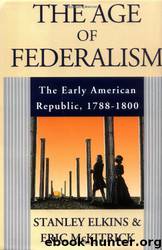
Author:Stanley Elkins & Eric McKitrick [Elkins, Stanley & McKitrick, Eric]
Language: eng
Format: epub
Tags: General, United States, History, Foreign Language Study, 19th Century, English as a Second Language, Federal Government, United States - Politics and Government - 1789-1809, United States Politics and Government 1789-1809
ISBN: 9780195068900
Google: KKlET6iHrusC
Amazon: 0195068904
Publisher: Oxford University Press
Published: 1993-08-26T00:00:00+00:00
So the situation was politically much inflamed; western Pennsylvania was becoming an especially strong salient of opposition sentiment, even though there had been a heavy proportion of support for the new federal constitution in that same area only a few years before. But in addition to all this (western Pennsylvania was not, after all, the only place in the country opposed to the excise) there were changes occurring in the economic and social environment of the region that generated strains of a very particular sort.
Western Pennsylvania in this period is commonly pictured as a society of frontier farmers, perhaps pinched for cash but sturdily independent, with high hopes for the future in a region of rapid population growth and an open, fluid social structure. At the very minimum, it was a setting in which a man might expect to own his own land and acquire a decent competence for himself and his family, given a little time and hard work. This, however, is not an accurate description of western Pennsylvania by the mid-1790s. The region was no longer experiencing -- in marked contrast to, say, Kentucky and Tennessee -- the soaring growth in population it had seen in the mid-1780s; western Pennsylvania, moreover, had reached a point in its economic development, with a degree of social stratification and differentiation of economic function, that would not be attained in those places for many years to come.
For instance, 40 percent of the taxable property was owned by the upper decile of taxpayers (about the proportion reached in Boston by 1771); more significantly, 40 percent of the names on the tax rolls were listed as "dependents." What this came to specifically was 20 percent tenant farmers, 6 percent farm laborers, 10 percent general laborers, and 4 percent unemployed poor. One-third of the rural population -- about 70 percent of the total -- were thus farmers without land. 73 Given the high cost of land, there was not a great likelihood of many of this class acquiring substantial amounts of it in western Pennsylvania. The rich lands of Ohio were tantalizingly near. But they were full of unpacified Indians; for the time being, and as far as anyone could tell for an indefinite time to come, there was no going into them. Even in Pennsylvania itself, a projected new settlement at Presqu'Isle had just been suspended by the federal government on the ground that it might stir up the Six Nations. 74
Meanwhile that proportion of the adult male population listed as "artisans" was 16 percent, as high as in the settled areas of eastern Pennsylvania, which is another way of saying that the region was well on its way to industrialization. Moreover, the sizable exports of flour and whiskey to New Orleans meant that a fair proportion of the farmers were engaged in all-out commercial agriculture. 75
Here, then, was a developing regional economy that felt itself being arbitrarily contained, hemmed in, and sat upon. The mountains to the east were both a natural and a psychological barrier that nobody could do much about.
Download
This site does not store any files on its server. We only index and link to content provided by other sites. Please contact the content providers to delete copyright contents if any and email us, we'll remove relevant links or contents immediately.
| Africa | Americas |
| Arctic & Antarctica | Asia |
| Australia & Oceania | Europe |
| Middle East | Russia |
| United States | World |
| Ancient Civilizations | Military |
| Historical Study & Educational Resources |
Cat's cradle by Kurt Vonnegut(15445)
Pimp by Iceberg Slim(14668)
4 3 2 1: A Novel by Paul Auster(12516)
Underground: A Human History of the Worlds Beneath Our Feet by Will Hunt(12145)
The Radium Girls by Kate Moore(12095)
Wiseguy by Nicholas Pileggi(5842)
The Fire Next Time by James Baldwin(5506)
Perfect Rhythm by Jae(5470)
American History Stories, Volume III (Yesterday's Classics) by Pratt Mara L(5338)
Paper Towns by Green John(5248)
Pale Blue Dot by Carl Sagan(5082)
A Higher Loyalty: Truth, Lies, and Leadership by James Comey(5018)
The Doomsday Machine by Daniel Ellsberg(4556)
The Mayflower and the Pilgrims' New World by Nathaniel Philbrick(4540)
Killers of the Flower Moon: The Osage Murders and the Birth of the FBI by David Grann(4489)
The Sympathizer by Viet Thanh Nguyen(4446)
Too Much and Not the Mood by Durga Chew-Bose(4388)
The Borden Murders by Sarah Miller(4382)
Sticky Fingers by Joe Hagan(4256)
